

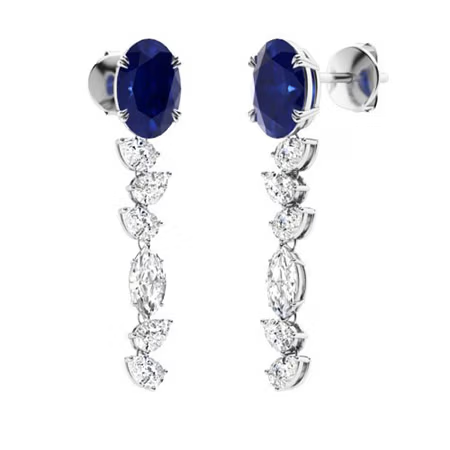
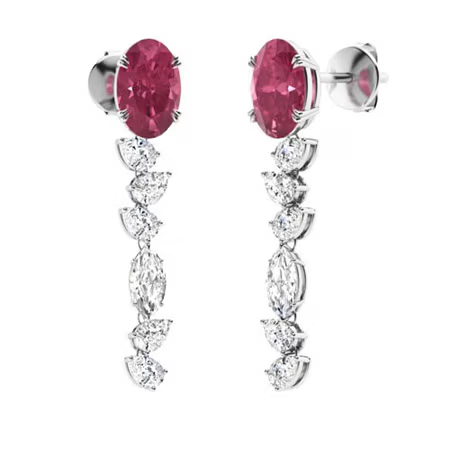
Sapphire earrings
Rated 2.00 out of 5
(3)
UPS SERVICE
Shipping & Returns
STORES
Find retail locations
FREE SHIPPING
For orders above €100
CUSTOMER CARE
For All Your Questions
 January Birthstone
Shipping & Returns
Find retail locations
For orders above €100
For All Your Questions
 February Birthstone
Shipping & Returns
Find retail locations
For orders above €100
For All Your Questions
 March Birthstone
Shipping & Returns
Find retail locations
For orders above €100
For All Your Questions
 April Birthstone
Shipping & Returns
Find retail locations
For orders above €100
For All Your Questions
 May Birthstone
Shipping & Returns
Find retail locations
For orders above €100
For All Your Questions
 June Birthstone
Shipping & Returns
Find retail locations
For orders above €100
For All Your Questions
 July Birthstone
Shipping & Returns
Find retail locations
For orders above €100
For All Your Questions
 August Birthstone
Shipping & Returns
Find retail locations
For orders above €100
For All Your Questions
 September Birthstone
Shipping & Returns
Find retail locations
For orders above €100
For All Your Questions
 October Birthstone
Shipping & Returns
Find retail locations
For orders above €100
For All Your Questions
 November Birthstone
Shipping & Returns
Find retail locations
For orders above €100
For All Your Questions
 December Birthstone
Shipping & Returns
Find retail locations
For orders above €100
For All Your Questions

September Birthstone
Sapphire is a gem-quality corundum composed of aluminum oxide (Al₂O₃). Its name comes from the Latin "Sapphirus," meaning "blue stone." As one of the world's five most precious gemstones, it is renowned for its rich colors, exceptional hardness, and cultural significance.
Major Global Producing Areas
cornflower blue
royal blue
$20-50 per carat
though the color is darker.
Chemistry and Crystal Structure
Sapphire is primarily composed of aluminum oxide and belongs to the hexagonal crystal system, with hexagonal columnar crystals commonly found. Its color is determined by trace elements:
Blue: The synergistic effect of titanium (Ti⁴⁺) and iron (Fe²⁺) creates the iconic “Muzo green” color of Colombian sapphires, such as the high-chromium, low-iron environment that creates the iconic “Muzo green” color.
Non-blue: Chromium (Cr³⁺) creates pink and orange (padparadscha), while vanadium (V³⁺) produces green. Yellow and purple colors are created by a combination of other trace elements. Special Optical Effects: Parallel rutile needle-like inclusions within the sapphire can create a six-rayed star (star sapphire). Sri Lanka once produced a giant 11,685 carat star sapphire, the “Purple Blue Star.”
Physical Properties
Hardness: 9 on the Mohs scale, second only to diamond, making it extremely wear-resistant and suitable for everyday wear.
Refractive Index and Luster: 1.76-1.77, vitreous luster, high transparency, but often containing natural inclusions (such as the “garden effect”).
Density: 3.95-4.10 g/cm³, with slight variations depending on origin (e.g., approximately 3.97 g/cm³ for Burmese sapphires).
Variety Classification
Blue Sapphires: The top varieties are Kashmir “Cornflower Blue” (indigo with a slight purplish hue) and Burmese “Royal Blue” (true blue or with a slight purplish hue).
Colored Sapphires: Available in pink, yellow, and green. Padparadscha (pinkish orange) commands a premium price due to its rarity. Special Varieties: Trapiche sapphire (six black radial lines), Cat’s-Eye Sapphire (parallel tubular inclusions create a cat’s-eye effect).
Consumers prefer gemstones with traceable origins. Companies like Gemfields are using nanoparticle tagging technology to achieve full traceability.
Consumers prefer gemstones with traceable origins. Companies like Gemfields are using nanoparticle tagging technology to achieve full traceability.
Non-traditional cuts (such as cabochons and carvings) and 3D printing and setting techniques are gaining popularity. Brands like Tiffany and Bulgari have launched sapphire-themed high-end jewelry collections.
While synthetic sapphire technology (such as CVD) is mature, natural sapphires still dominate the high-end market, with cultivated sapphires costing only 20%-30% of their natural counterparts.
No account yet?
Create an Account


 Earrings
 Men’s
Men’s Necklaces
 Rings
Rings Engagement Rings
 Wedding Rings
 Accessories